Furious Violet book launch
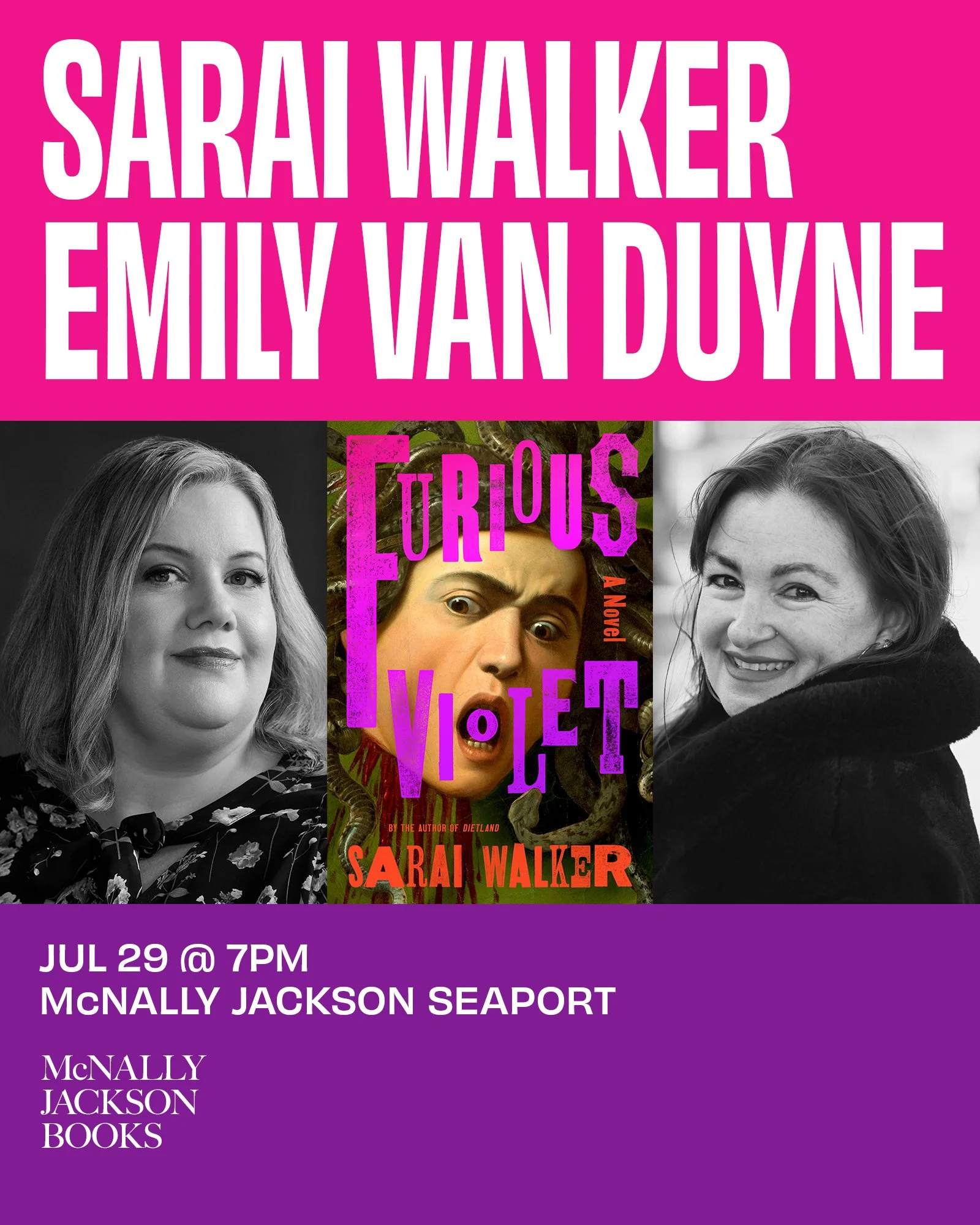
McNally Jackson bookstore in New York City (Seaport location) will be hosting the book launch for Furious Violet! I will be in conversation with Emily Van Duyne, author of Loving Sylvia Plath, on July 29th at 7pm. Please register HERE.
I hope to see you there!
France & belgium book tour
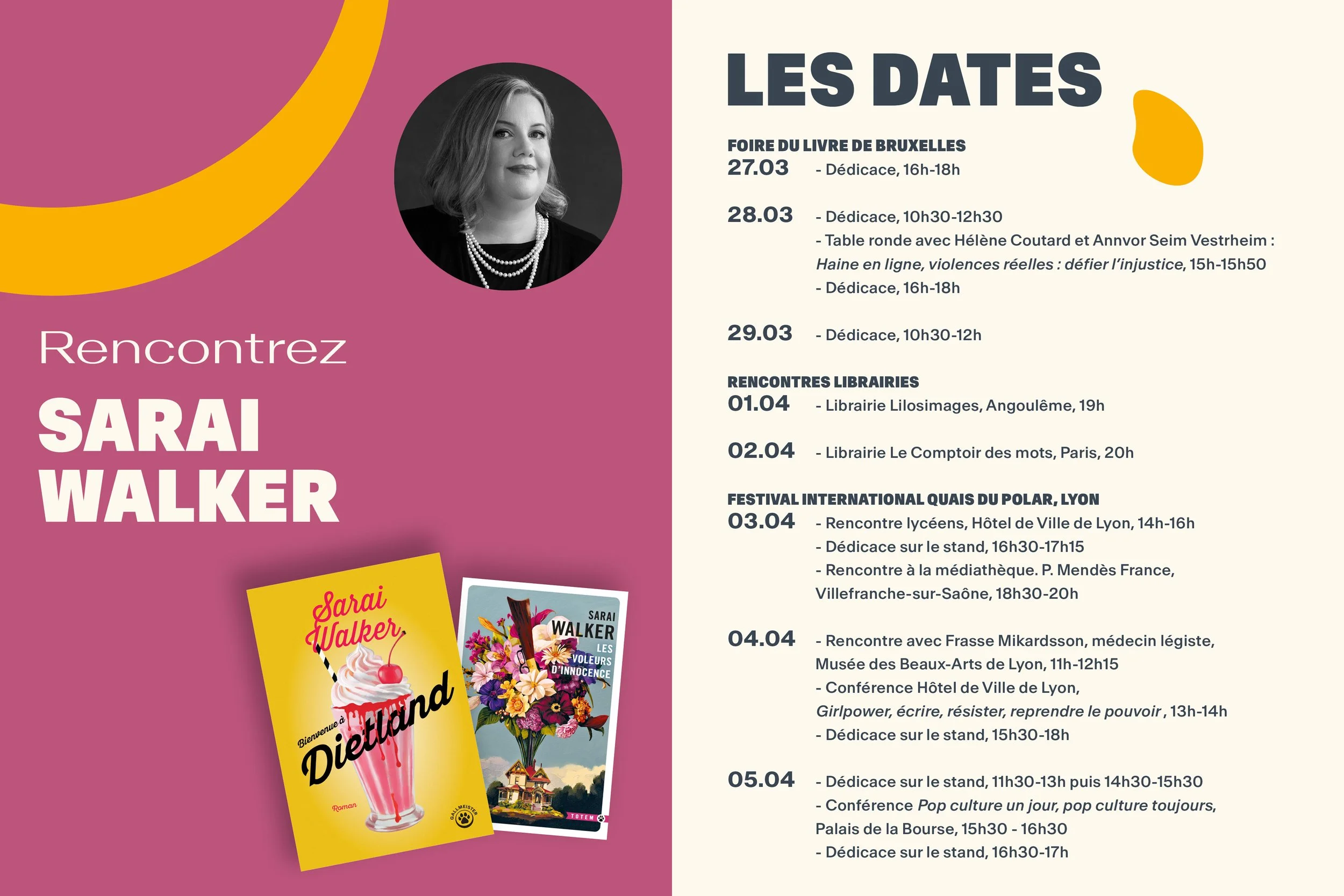
I’ll be doing a series of events in France and Belgium to promote the French language re-publication of Dietland (Bienvenue á Dietland). I’m so excited to be doing this tour with my French publisher, Gallmeister.
New Website for TCR
Thanks so much to Ilsa Brink for redesigning my website for The Cherry Robbers. I absolutely love it. Once you’ve read the book, you’ll be able to appreciate all the design choices she made. Ilsa really captured the essence of the novel and gave me the gothic beauty that I wanted.
I will aim to post updates here from now on, which will also be cross-posted on my social media accounts.
The Sugar Plum Interview: 3 Questions for Joy Nash
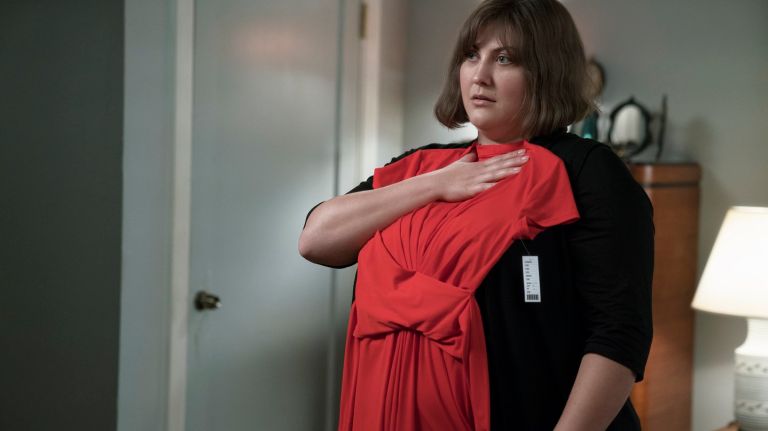
For finale night, I have an interview with the one and only Joy Nash, aka Plum Kettle! Besides her starring role in Dietland, Joy has appeared in Twin Peaks: The Returned, The Mindy Project, The Fosters and many other shows. She has also narrated many audiobooks. Joy’s video “A Fat Rant” went viral in 2007, and introduced many people to fat positivity for the first time. If you haven’t seen it, head over to YouTube (once you’re done with this interview, of course).
Thanks to Joy for her fearless and heartfelt portrayal of Plum this season. As the controversy surrounding Insatiable shows, not to mention the fat-suited guy in This Is Us, a fat actor playing a fat character is still not something we can expect in 2018. I’m so glad Joy got a chance to shine in this role, and to show the world what fat ladies can do.
SARAI: I think people often assume that those of us who are “fat positive” love our bodies unconditionally and never experience any negative feelings or anxiety about how we look. Therefore, “fat positivity” can seem like something impossible for the average person to participate in. I think there are a lot of misconceptions about what fat positivity is. I’m wondering what fat positivity means to you, and what advice you can give fat people who are struggling with this concept.
JOY: Fat positivity for me is about power. I love that Serena Williams quote: “This is my body. It’s my weapon and my machine.” ‘Beautiful’ doesn’t mean much to me -- it’s totally subjective and not really useful. What does it get you? Love? Safety? Not in my experience. This is my body; I did not ask you what you thought of it. If it terrifies you, GOOD. Obviously I still have things to work through, but to me, Fat positivity is rejecting the notion that my worth is attached to my body. This is a bag of bones -- MY bag of bones -- that I am using to get where I want to go.
SARAI: What was your favorite scene to film this season? What was the most challenging scene?
JOY: The costumes for the fashion show fantasy were so much fun; learning how to take a punch in the face was fun, and honestly the nude scene was a favorite! It was kind of last minute. In the script it was just Plum in her regular clothes typing on her computer, but at 8am Helen Shaver [the director] said “I’ve got an idea!” And then 30 minutes later I was naked. I feel like every time we get an actual fat body on screen, it’s a victory. It’s one more opportunity for people to see themselves and feel less alone. I loved too that it was a quiet, reflective moment -- Plum was by herself, sketching herself, really looking at herself, which I think is a really powerful way to reclaim your own fat body.
SARAI: Other than Plum, what would your dream role be? [Marti Noxon suggested this question!]
JOY: Plum is an utter dream and my fingers might break they’re crossed so hard for next season. But otherwise -- so many! Top of the list, I’d like to play Belle Gunness -- America’s first female serial killer, but I’d also love to star in a feature version of my solo show: My Mobster, about a relationship I had with a criminal from France. I’d also love to play a romantic lead -- maybe a romance novel audiobook narrator who gets carried away in the stories she narrates. Oh, and an evil queen. [You know, a little of everything. Maybe Marti will help ;) ]
Connect with Joy:
Twitter: @JoyNash
Instagram and Facebook: @therealjoynash
The Sugar Plum Interview: 3 Questions for Janine Nabers

I’m thrilled to interview Janine Nabers, one of the Dietland writers and producers — and someone who is a complete joy to work with. Besides being an in-demand television writer, Janine is an acclaimed playwright. She’s a graduate of the Lila Acheson Wallace Playwriting Fellowship at Juilliard and winner of the 2014 Yale Drama Series Prize for her play “Serial Black Face.” She was recently awarded the Fadiman Award from Center Theater Group in LA for her upcoming play about “The Peterson Show.” She is also the librettist to an upcoming Sylvia Plath musical called “Mrs. Hughes.” Janine is currently developing a TV show with Paramount.
SARAI: You wrote the sixth episode of Dietland, when Plum is in the basement of Calliope House and encounters the notorious “porn room.” This was one of the most difficult sections of the novel to write, and I imagine writing the script was similarly difficult. What challenges did you face writing this episode?
JANINE: Being a playwright, I think writing the basement episode was less daunting to me than others, but it was still pretty freaking hard. Our writers room re-broke that episode maybe seven or eight times. And then it was just me in a room writing it. By then my contract with the show had ended and all the writers were off writing. So it was a little isolating. There were a number of pieces to the puzzle of Plum that still hadn’t been worked out. In the end it was a lot like giving birth to a whole new person.
Up until episode six Plum has had so many forms of feminist agenda thrown at her and then she literally gets punched in the face. I was racially attacked on a street by a man in 2016. It was one of the most traumatizing experiences of my life. So I think writing that episode gave me closure in a lot of ways. And I think, like Plum, I walked away with a whole knew perspective of life and self-preservation in a world that’s filled with violence. Be it physical or sexual.
And then there’s the porn hub! I’ll be the first to admit that I love porn, but I also understand that brutality in porn has influenced the rise of sex crimes in a big way. So Plum watching a woman being hit like she was on the street but enjoying it as an act of sex brutality, obviously that is a trigger for her… Plum walks out of that basement feeling like she finally has control of her body and her mind. And that’s a powerful thing. Now the viewers will see Plum form her own opinion of her body, feminism, porn, and so on. Plum is just getting started. And it’s exciting that I got to write her turning point.
SARAI: You’re a playwright and a television writer. There are obvious similarities between these genres, but I’m wondering about the key differences from the perspective of a writer.
JANINE: Playwriting is all yours. It’s a story only you can write. And the characters will never, ever be recreated because it’s your actual DNA on stage. TV writing is all about putting several brains together and telling one story. It takes a village to tell five seasons of one show. And every episode is filtered through the voice of the show’s creator. I love both forms of storytelling so much. And I think they are both skill sets that not everyone can master. Some people have a really hard time writing in someone else’s voice. I love it. But I also love walking away every once in a while, locking myself in a room and writing a story for an audience of only 200 people.
Playwriting is so wildly creative. It gives you a voice that’s easier to stand out. It’s what got me into Hollywood in the first place and TV writing will only make my plays more accessible. It’s a win win.
SARAI: As a woman of color in an industry with a long history of sexism and racism, do you think things are changing for the better? There’s a widespread assumption that the industry is growing more diverse, but I’m wondering how you see it.
JANINE: A Black friend of mine said it well when he said, “equality looks like imbalance.” So while there is progress being made by adding more diverse writers in Hollywood, I think a lot of people are under a false assumption that there are TV rooms overflowing with minority writers right now. And honestly, it’s just not the case. Yes, progress is being made. More minorities, women and queer writers are getting writing jobs. But equality is a long, long road ahead. White men are still the majority. And they will be just fine.
You know, it’s interesting. I’ve worked with Marti on and off for most of my television writing career and I’ve been lucky to have a lot of female bosses in the last 4 and a half years. So I’ve been fairly sheltered from a lot of industry BS. (Which is why I love working for her). :) But I have worked for white people who hired me for reasons where I feel like my Blackness was exploited. I get that there are a lot of powerful White showrunners trying to tell minority stories that intrigue them, but in two very specific cases I felt like I was only in the room so that very out of touch white people in power could get their story on the air.
BTW - It’s really cool to be “trending” in Hollywood. And “otherness” is all the rage right now. A lot of minority writers like myself are being hired to hold the hand of White people who are not equipped to write the stories they are being paid millions of dollars to write. “Tokenisim” is a huge part of racism. And I really wish more liberal people in this industry understood that.
Connect with Janine on Twitter: @J9Nabers
And check out this article about Janine and other playwrights working in TV.